
Why Is My House So Cold Even With the Heating On?
Reviewed 2026-08-01 · How we research
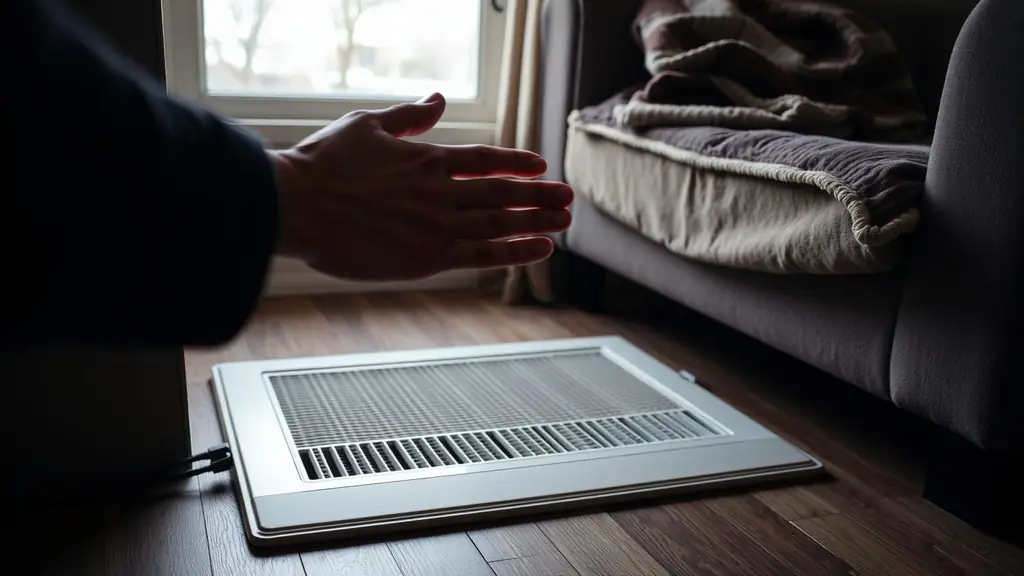
Quick answer: a house that feels so cold even with the heating on
When heat runs constantly but the house stays cold, airflow is usually restricted by a dirty filter or leaky ducts, or the heat pump is struggling in cold weather without backup heat engaging. Less often, the equipment is undersized or the building envelope is losing heat faster than the system can replace it.
Urgent — act now
The equipment is running, so this is not an immediate safety emergency, but a house that stays cold in freezing weather risks frozen pipes if not resolved within days.
A system that runs but does not warm the house is a different problem than a system with no heat at all — the equipment is at least attempting to work, which narrows the list of likely causes. The two broad categories are airflow or delivery problems (the heat is made but doesn't reach the rooms) and capacity problems (the system can't make enough heat for the conditions).
Work through delivery issues first since they are cheaper and faster to check, then consider whether the equipment itself is simply undersized or underperforming for the outdoor temperature.
Warning signs of a house that feels so cold even with the heating on
- Furnace or heat pump runs almost continuously without the house warming
- Some rooms are warm while others stay cold
- Supply air feels only lukewarm at the registers
- Thermostat shows the setpoint is not being reached even after hours of runtime
Most likely causes of a house that feels so cold even with the heating on, ranked
1. Dirty filter restricting airflow
Most common — cheapest to check
A clogged filter chokes the amount of air the blower can push across the heat exchanger or coil, reducing how much heat actually reaches the ducts even while the burner or compressor runs normally.
10-minute self-test: Pull the filter and hold it to a light source. If light barely passes through, replace it and see whether register airflow improves within the hour.
2. Weak airflow from a struggling blower or blocked returns
Common
Furniture or rugs blocking return air grilles, a failing blower motor, or closed interior doors that cut off return airflow all reduce the volume of air moving through the system, which lowers delivered heat even when the heat source itself is fine.
10-minute self-test: Check that no furniture blocks return grilles and that doors to rooms with only a supply vent (no return) are left slightly open to let air circulate back.
3. Duct leakage in an attic, crawlspace or basement
Very common in older duct systems
Typical residential duct systems lose a meaningful share of the air they carry to leaks at joints and connections. Any run through an unconditioned attic or crawlspace loses heat to that space before the air ever reaches the register.
10-minute self-test: Compare airflow and warmth at the register closest to the furnace with one at the far end of the house. A large gap points to duct leakage or an unbalanced system rather than the equipment itself.
4. Thermostat problems — bad location or miscalibration
Common
A thermostat mounted near a supply vent, in direct sun, or on an exterior wall reads a temperature that does not match the rest of the house, so it satisfies early and the system shuts off before other rooms warm up.
10-minute self-test: Hold a separate thermometer near the thermostat for 15 minutes and compare readings. A gap of more than a couple degrees suggests a location or calibration issue.
5. Furnace short-cycling or firing problem
Common
A furnace that shuts off after only a few minutes of runtime — from a dirty flame sensor, a failing limit switch, or restricted intake or exhaust venting — never reaches steady-state output long enough to warm the house.
10-minute self-test: Time the burner cycles. Runs under five minutes, repeated over and over, indicate short-cycling that needs a technician rather than a thermostat adjustment.
This cause is not a DIY repair — it needs a hvac technician.
6. Heat pump losing capacity in cold outdoor temperatures
Common with heat pumps in cold climates
Heat pumps extract heat from outdoor air, and their output naturally drops as outdoor temperature falls. Below roughly freezing, many heat pumps can no longer keep up with heat loss on their own, which is normal physics, not necessarily a malfunction.
10-minute self-test: Check the outdoor temperature against your system's rated capacity in the owner's manual. If it is well below the point where the manufacturer expects the compressor alone to keep up, backup heat is supposed to be assisting.
7. Auxiliary or emergency heat not engaging on a heat pump
Common in cold snaps
Heat pumps rely on electric resistance or a furnace backstop to cover the gap in cold weather. If that auxiliary heat fails to engage — a bad control board, tripped breaker on the strip heat circuit, or thermostat staging problem — the house falls behind on cold days even though the compressor runs continuously.
10-minute self-test: Watch the thermostat display for an 'Aux Heat' or 'Emergency Heat' indicator during a cold snap. If it never appears despite the house losing ground on temperature, have a technician check the staging and the strip-heat breaker.
This cause is not a DIY repair — it needs a hvac technician.
8. Frozen outdoor unit or low refrigerant charge
Less common
A coil coated in ice blocks airflow across the outdoor unit, and low refrigerant reduces how much heat the system can move regardless of runtime. Both require a licensed technician; refrigerant work cannot be done by a homeowner.
10-minute self-test: Look at the outdoor unit for a solid ice buildup rather than light frost. Do not attempt to clear it with tools; call a technician.
This cause is not a DIY repair — it needs a hvac technician.
9. Undersized equipment or major envelope heat loss
Less common but decisive when present
A furnace or heat pump sized for a smaller house, or a building losing heat quickly through poor attic insulation and air leakage, can leave the system unable to keep up no matter how well it is maintained.
10-minute self-test: Check attic insulation depth; less than about 10 inches of blown insulation suggests significant heat loss that no amount of furnace runtime will overcome.
What it costs to fix a house that feels so cold even with the heating on
| Cause / repair | DIY cost | Professional cost |
|---|---|---|
| Filter replacement | $8–$25 | n/a |
| Clearing return grilles / opening interior doors | $0 | n/a |
| Duct sealing with mastic | $30–$80 | $900–$3,000 |
| Thermostat relocation or replacement | $50–$150 | $150–$400 |
| Flame sensor / limit switch service | n/a | $150–$450 |
| Auxiliary heat control or breaker repair | n/a | $200–$700 |
| Attic insulation top-up to R-49 | $500–$1,200 | $1,700–$4,500 |
See the full cost breakdown for this repair →
DIY fixes for a house that feels so cold even with the heating on
Replace the filter and check it monthly through winter
This is the single highest-return five minutes you can spend on a cold, heat-on house.
Open interior doors slightly on rooms without a return vent
This restores the air path back to the furnace and can noticeably improve delivered heat within a day.
Move furniture and rugs off return air grilles
A blocked return chokes the whole system's airflow, not just one room.
Add attic insulation over already air-sealed penetrations
Confirm the attic hatch, top plates and chases are sealed first, then top up insulation to reduce ongoing heat loss.
Mistakes to avoid with a house that feels so cold even with the heating on
- Do not keep raising the thermostat setpoint hoping a struggling system will catch up — it usually just runs longer without closing the gap
- Do not attempt to clear a frozen outdoor unit yourself
- Do not ignore an Aux Heat light staying on constantly; that usually means the compressor side has stopped contributing
Where homeowners waste money on a house that feels so cold even with the heating on
- Replacing a working furnace before confirming the problem is airflow or ducts, not the heat source itself
- Buying a bigger heat pump without checking whether backup heat is even engaging on the current one
- Sealing supply registers in warm rooms to 'push' heat elsewhere, which usually raises duct pressure and worsens leaks
When to call a hvac technician about a house that feels so cold even with the heating on
Ask the technician to check static pressure across the blower, not just look at the equipment — restricted airflow is invisible without a gauge.
For heat pumps, ask specifically whether auxiliary heat is staging correctly during a cold-weather test call.
Request a duct leakage test if rooms far from the furnace stay noticeably colder than rooms near it.
What a hvac technician actually does on this job →
How to prevent a house that feels so cold even with the heating on coming back
- Change filters every 60–90 days through the heating season
- Have ducts inspected and sealed if the home has ducts in an unconditioned attic or crawlspace
- Have a Manual J load calculation done before assuming a bigger furnace will fix a cold house
Why Is My House So Cold Even With the Heating On — questions homeowners ask
Why does my furnace run all day but the house never gets warm?
Continuous runtime without reaching setpoint points to restricted airflow (dirty filter, blocked returns), duct leakage losing heat before it reaches rooms, or equipment that is undersized or short-cycling.
Is it normal for a heat pump to feel like it can't keep up in very cold weather?
Some capacity loss in cold outdoor air is expected physics, which is why heat pumps pair with backup heat. If backup heat isn't engaging when it should, that's a control problem worth a service call.
Why is one room always colder than the rest even with the heat running?
A single cold room usually points to a duct run losing heat in an unconditioned space, a closed or blocked register, or that room having more exterior wall and window exposure than others.
Can bad insulation really overpower a working furnace?
Yes. A furnace sized for a properly insulated house can lose the race against heat loss in an under-insulated one, especially during cold snaps, even while running perfectly.
Should I turn the fan to ON to move more heat around?
Running the fan continuously can help even out room-to-room temperatures in some homes, but it will not fix a duct leak or capacity shortfall and adds to electricity use.
How do I know if my thermostat location is the problem?
Compare a separate thermometer's reading near the thermostat to readings in other rooms. If the thermostat area runs consistently warmer than the rest of the house, it's shutting the system off too early.
Problems related to a house that feels so cold even with the heating on
- Why Is My House Not Heating Up?Same part of the house — A house with zero heat is usually a thermostat set wrong, a tripped breaker, a clogged filter, or an interrupted fuel supply — propane out, gas shut off, or a furnace safety lockout.Heating, Cooling & Air Urgent — act now
- Why Is My House Heater Blowing Cold Air?Same part of the house — Air coming out cold usually starts with the fan switch set to ON instead of AUTO, or the thermostat set to Cool instead of Heat.Heating, Cooling & Air Urgent — act now
- Why Is My House Getting Weak Airflow From the Vents?The same hvac technician handles this one. Weak vent airflow is most often caused by a clogged air filter restricting the blower, followed by duct leaks, closed or blocked registers, and undersized or crushed ductwork.Heating, Cooling & Air Get it inspected
- Why Is My House So Cold?Same part of the house — Most cold houses lose heat through air leaks and thin attic insulation, not through a weak furnace.Heating, Cooling & Air Get it inspected
- Why Is My House Getting Hot Upstairs?The same hvac technician handles this one. Upstairs rooms run hotter mainly because heat naturally rises (the stack effect) and because attic heat radiates down through the ceiling.Heating, Cooling & Air Get it inspected
Sources used for a house that feels so cold even with the heating on
- U.S. Department of Energy — Heating Systems
- ENERGY STAR — Home Sealing and Insulation
- ACCA — Manual J residential load calculation standard
- Carrier — technical resources
- Air Conditioning Contractors of America — duct design standards